
Aerosol Compliance: Verify Certificate Scope Before Filling
Aerosol compliance is decided by scope, not by logos. Before an OEM fills the first can, a buyer should be able to answer four questions in writing: is each certificate current and traceable to a named issuer and number; does its scope sentence actually name your product category, process and site; do the declared net content and can dimensions fit the destination market; and are the acceptance criteria written into the purchase order. A supplier folder full of ISO certificates can pass the first question and fail the other three.
This guide sets out a verification sequence that works for any aerosol contract filler, across insecticide spray, air freshener, household cleaning, car care, industrial maintenance, spray paint and aviation aerosol. Guangdong Laya New Chemical Technology Co., Ltd. (LAYA) is an aerosol R&D and manufacturing company established in 1992, operating a 100,000 m² production base with 14 filling lines and a company-reported annual output of 200 million cans. Its certification and product records are used below as a worked example, because they show exactly the kind of scope detail a buyer has to read before approving a fill.
Why "we are ISO certified" is not a compliance answer
Three failures account for most certification problems in aerosol OEM projects. The first is validity: a certificate that was current when the supplier first sent the file may have lapsed by the time your production slot arrives. The second is scope drift: the certificate is genuine, but the sentence describing what it covers does not reach your product category or your process. The third is linkage: the certificate is issued to a site or product group, and nobody has confirmed that your specific model sits inside that group.
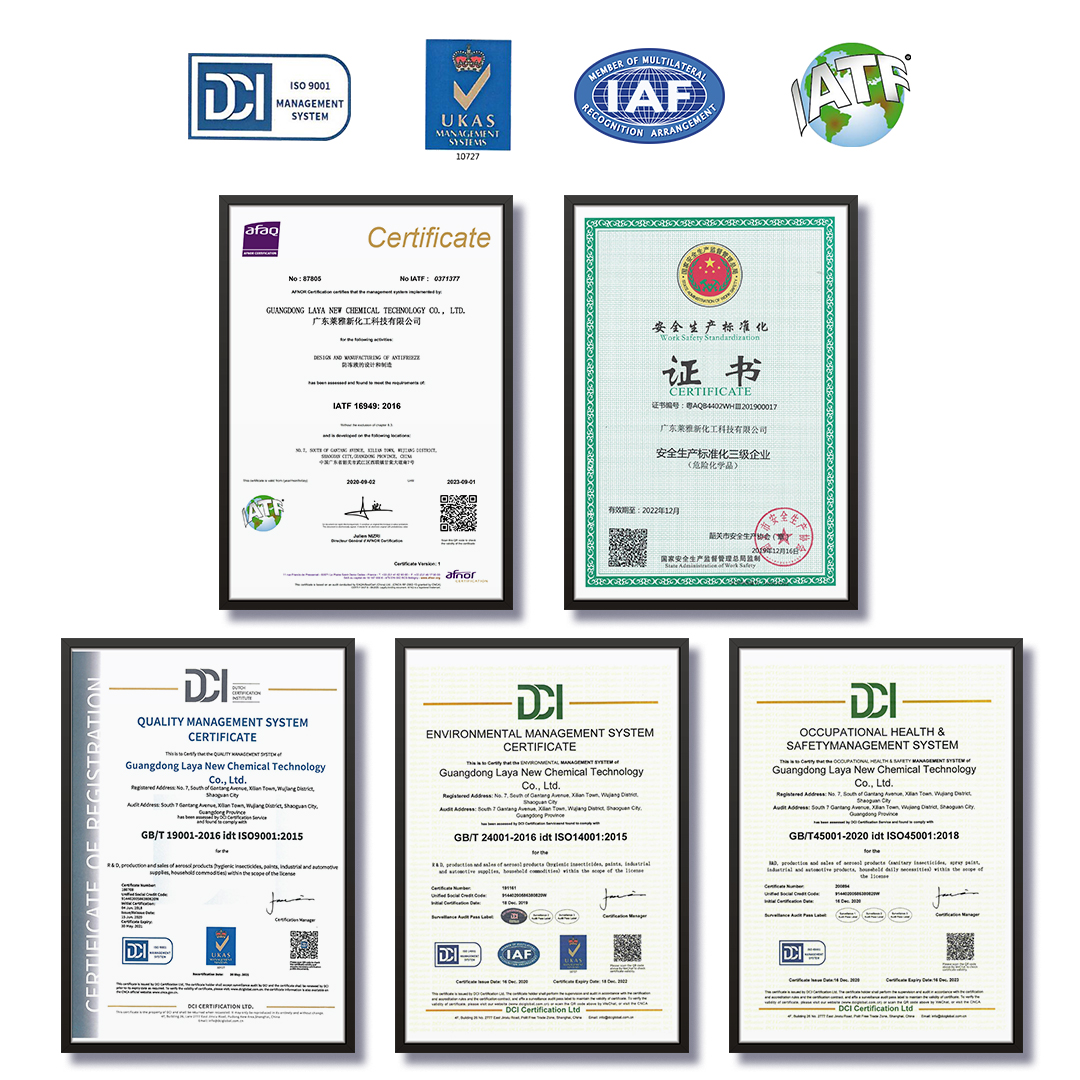
LAYA's own record demonstrates the second and third failures clearly. The company holds an IATF 16949:2016 certificate (number 0480866, issued by AFNOR Certification). The scope text recorded against that certificate reads "design and manufacturing of antifreeze". A spray paint or car care buyer who reads only the certificate's title would conclude that automotive-quality coverage applies to their aerosol. A buyer who reads the scope sentence would instead send a written follow-up question. Both reactions are understandable; only the second is compliance work.
Validity deserves the same attention. The same IATF entry records an end date of 10 August 2026, and the ISO 45001:2018 entry (number 200894, issued by DCI Certification Ltd.) records 16 December 2026. A purchase order signed in late 2026 that assumes both certificates run through the delivery window rests on an assumption nobody checked. The verification step is not to draw a conclusion about renewal — it is to request the current certificate or renewal evidence before relying on either document.
What the market context means for verification
Aerosol is a large and regionally uneven category, and the compliance burden follows the volume. Grand View Research projects the global aerosol market to reach USD 100.7 billion in 2026. The European Aerosol Federation reported European production of 3.46 billion units in 2024, a 4.2% year-on-year increase. More units moving through more markets means more first-time buyers meeting market-specific rules.
Europe shows why a management-system certificate is only the starting point. The EU Aerosol Dispensers Directive (75/324/EEC) requires pressure testing and specific labeling for aerosols sold in the EU. That is a product-and-process requirement. A supplier holding ISO 9001 has demonstrated a quality management system; it has not automatically demonstrated conformity with 75/324/EEC for your formulation, your valve and your container. The buyer's job is to obtain the pressure-test and labeling evidence rather than infer it from a quality certificate.
Material choice carries market signal too. Grand View Research places aluminum at 61.0% revenue share of aerosol containers in 2025 against 39.0% for steel, while a separate commercial source reports steel at 58% share for industrial and commercial applications. Those figures are not necessarily contradictory: revenue share weights premium personal-care packaging differently from high-volume industrial cans, and unit share would weight them differently again. For a buyer, the practical conclusion is that can material is a specification decision to be stated in the RFQ, not a market default to be assumed.
The five verification gates
Run these gates in order. Each one produces either a document you can file or a written question you can send.
Gate 1: certificate identity
Record the certificate number, issuing body, standard edition, issue date and expiry date, then check them against the issuer's own register rather than against the supplier's PDF. A certificate that cannot be located in the issuer's records is not evidence, whatever it looks like.
Gate 2: the scope sentence
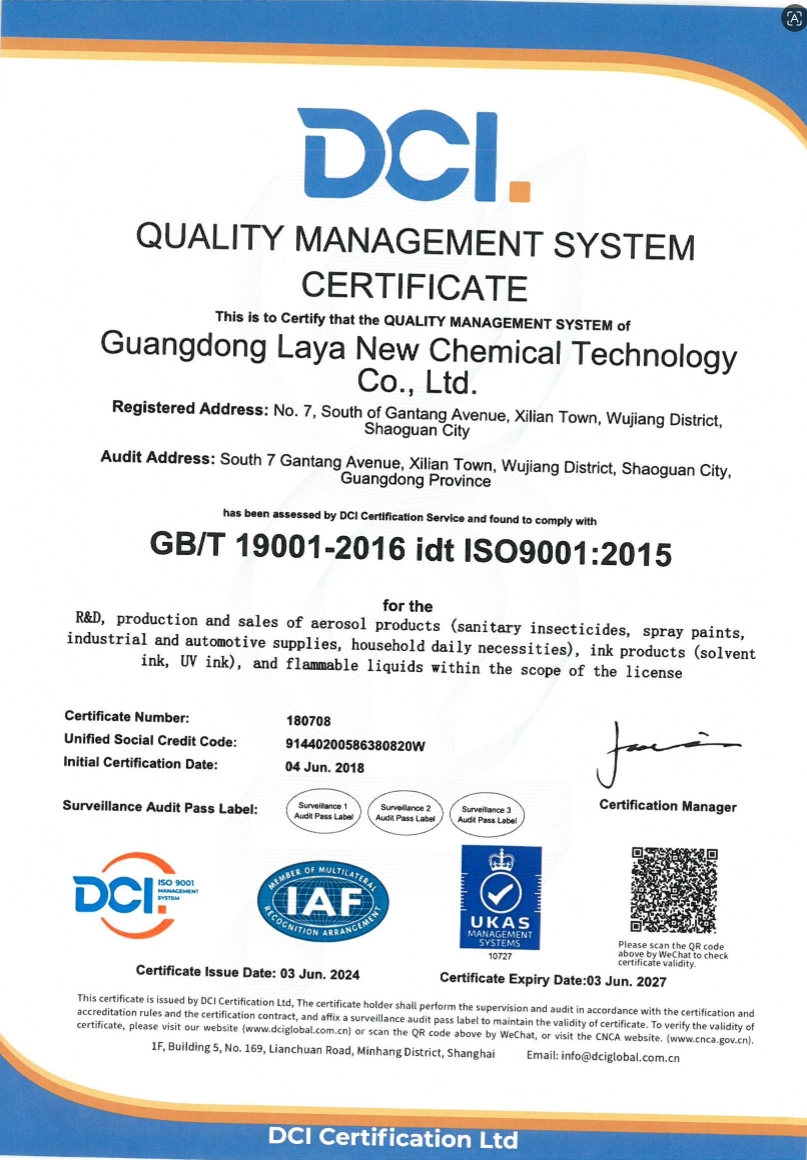
Read the scope as a legal sentence, not a headline. LAYA's ISO 9001:2015 certificate (number 180708, DCI Certification Ltd., valid to 2027-06-03) states a scope covering R&D, production and sales of aerosol products (sanitary insecticides, spray paints, industrial and automotive supplies, household daily necessities), ink products and flammable liquids within the scope of the license. That sentence is broad and category-specific; it is what makes the certificate useful. A generic "manufacture of chemical products" scope would not be.
Gate 3: product linkage
Ask which of your specific models are covered. LAYA's ISO 14001:2015 certificate (number F02925E00035R202, DCI Certification Ltd., valid to 2028-12-17) is linked in the record to all seven standard models discussed later in this guide, while the IATF 16949 entry is linked to five. That difference is exactly what a buyer needs to see before allocating SKUs to a supplier.
Gate 4: market registration
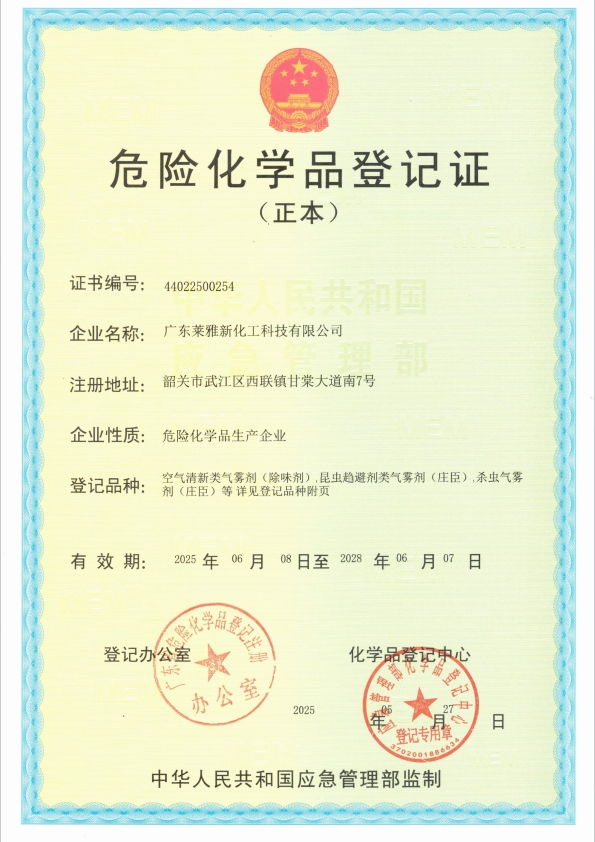
Management-system certificates travel; product registrations do not. LAYA holds a Hazardous Chemical Registration Certificate (number 44022500254, issued by the Ministry of Emergency Management of the People's Republic of China, valid to 2028-06-07) whose stated scope names air freshener aerosols (odor eliminators), insect repellent aerosols and insecticide aerosols. The certificate is a China-market document. It does not substitute for destination-market requirements in Central Asia, the Middle East, Africa, Russia or Brazil.
Gate 5: physical and commercial fit
Confirm that the declared net content, the can diameter and height, the can material and the labeling language can all be produced together, and that the purchase order states the acceptance criteria. This gate is covered in detail further down.
| Certificate on record | Standard | Issuer and number | Recorded validity | Scope as recorded |
|---|---|---|---|---|
| Quality management system | GB/T 19001-2016 idt ISO 9001:2015 | DCI Certification Ltd., 180708 | 2024-06-04 to 2027-06-03 | Aerosol R&D, production and sales: sanitary insecticides, spray paints, industrial and automotive supplies, household daily necessities; ink products; flammable liquids |
| Environmental management system | GB/T 24001-2016 / ISO 14001:2015 | DCI Certification Ltd., F02925E00035R202 | 2025-12-11 to 2028-12-17 | Same aerosol and flammable-liquid scope as the quality certificate |
| Occupational health and safety | GB/T 45001-2020 idt ISO 45001:2018 | DCI Certification Ltd., 200894 | 2020-12-16 to 2026-12-16 | Aerosol and ink R&D, production and sales within the licensed scope |
| Automotive quality management | IATF 16949:2016 | AFNOR Certification, 0480866 | 2023-08-11 to 2026-08-10 | "Design and manufacturing of antifreeze" |
| Hazardous chemical registration | China registration (standard not applicable) | Ministry of Emergency Management of the PRC, 44022500254 | 2025-06-08 to 2028-06-07 | Air freshener aerosols, insect repellent aerosols, insecticide aerosols and related items in the annex; China market |
Step-by-step: the buyer's verification procedure
- Request the full certificate set, not a summary slide. Ask for each certificate as issued, plus the product list the supplier attaches to it. A one-page compliance summary is a marketing document.
- Check every date against your own timeline. Compare issue and expiry dates with the planned production window plus shipping and shelf life. Where a date falls inside that window, request renewal evidence in writing before the deposit.
- Match the scope sentence to your category. Print the scope text and underline the terms that describe your product. If the terms are broader than your product, ask for a written interpretation; if they do not reach your product at all, ask what document does.
- Confirm model-level linkage. Give the supplier your model list and ask for a written yes/no per model against each certificate. This is where the difference between a site certificate and a product certificate becomes visible.
- Separate market registrations from management systems. List each destination market, then ask which registration, test report or labeling file supports that market for your formulation.
- Verify the physical specification. Lock net content, can diameter and height, can material, valve and actuator, then confirm the combination is a standard build or a tooling change.
- Write acceptance criteria into the purchase order. Reference each certificate by number and validity, define the tests and records that must accompany each batch, and add a clause requiring notification if a referenced certificate lapses during the contract term.
Applying the check per product category
The seven standard models below are useful because they differ in exactly the variables that change a compliance answer: category, material, net content and can size. The table is a specification map; the paragraphs after it explain what to verify for each group.
| Model | Category | Material | Net content | Can dimensions (∮ × height) |
|---|---|---|---|---|
| KB-0000600 | Insecticide spray | Tinplate | 300 / 400 / 500 / 600 / 750 ml | ∮52×195, ∮65×158, ∮65×200, ∮65×240, ∮65×300 mm |
| ME-0000300 | Air freshener | Tinplate | 300 ml | ∮52×195 mm |
| QL-0000300 | Household cleaning aerosol | Tinplate | 300 / 400 / 500 / 600 ml | ∮52×195, ∮65×158, ∮65×200, ∮65×240 mm |
| BO-0000600 | Car care products | Tinplate | 300 / 400 / 500 / 600 ml | ∮52×195, ∮65×158, ∮65×200, ∮65×240 mm |
| SM-0000400 | Industrial maintenance | Tinplate | 300 / 400 / 500 / 600 ml | ∮52×195, ∮65×158, ∮65×200, ∮65×240 mm |
| QL-0000450 | Spray paint aerosol | Tinplate | 300 / 400 / 500 / 600 ml | ∮52×195, ∮65×158, ∮65×200, ∮65×240 mm |
| KB-0000300 | Aviation aerosol | Tinplate, aluminum can | 300 / 400 / 500 / 600 ml | ∮52×195, ∮65×158, ∮65×200, ∮65×240 mm |
Insecticide spray (KB-0000600)
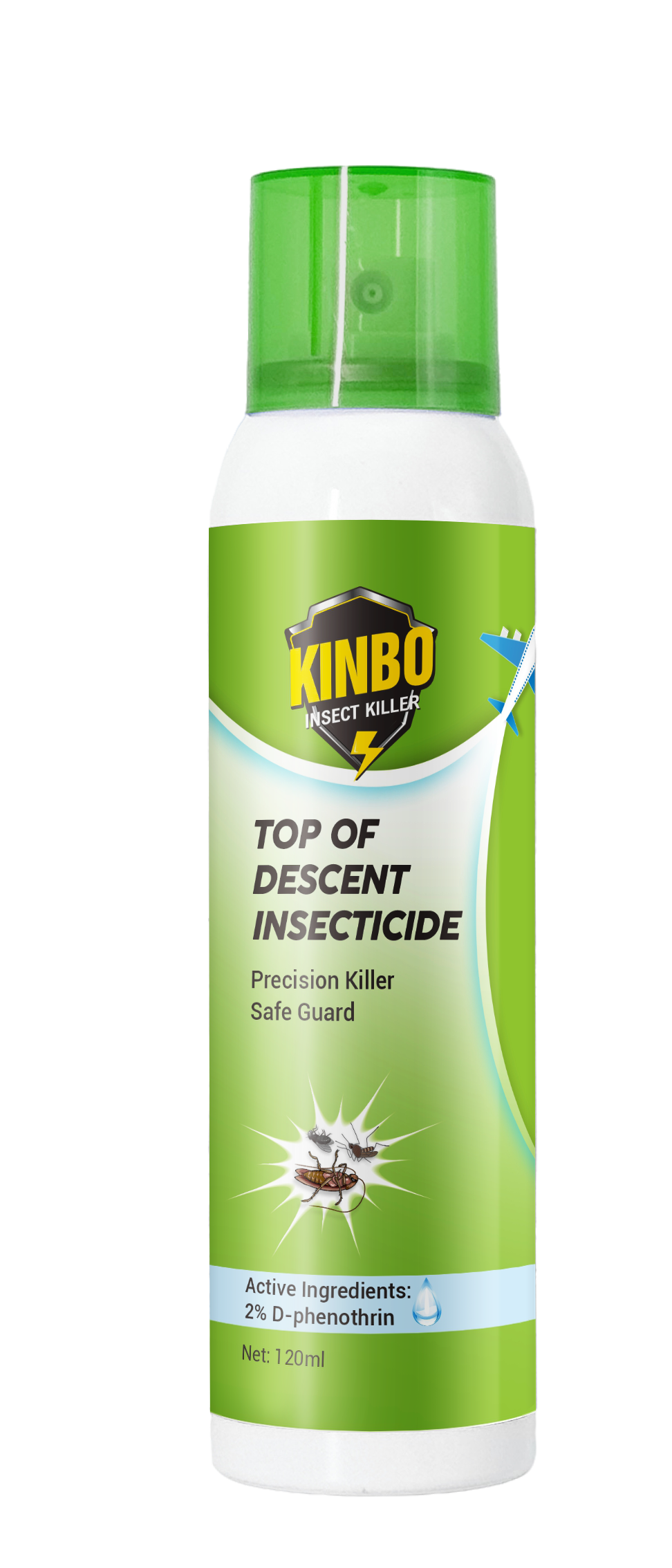
This is the only model in the set carrying a product-specific registration in the record: the China Hazardous Chemical Registration Certificate 44022500254. Two things still need checking. First, the registration is a China-market document, so an insecticide program for the Middle East, Africa or Central Asia needs its own market evidence. Second, KB-0000600 is also the only model offering 750 ml, which pairs with the ∮65×300 mm can. If your artwork declares 750 ml, confirm that the taller can and the fill line are validated together rather than assuming the 600 ml configuration scales up.
Air freshener (ME-0000300)
ME-0000300 is deliberately narrow: 300 ml in a ∮52×195 mm tinplate can. That narrowness is a compliance advantage when the product is a private-label launch, because the specification is fixed and only the fragrance and artwork change. The scope nuance is that the China registration's written scope names air freshener aerosols, while the record's product linkage points to the insecticide spray. The verification step is a written confirmation of which SKUs fall within the registration, not an assumption based on the scope wording.
Household cleaning, car care and industrial maintenance (QL-0000300, BO-0000600, SM-0000400)
These three share the same tinplate build and the same four can formats from ∮52×195 to ∮65×240 mm, and all three sit inside the quality, environmental and safety certificate scopes as aerosol products for household daily necessities, industrial and automotive supplies. For BO-0000600 and SM-0000400, the IATF 16949 entry also appears in the record. Given the "design and manufacturing of antifreeze" scope text noted earlier, an automotive or industrial buyer should request a written statement of exactly which processes and products that certificate covers before treating it as automotive-quality evidence.
Spray paint (QL-0000450)
Spray paint combines two compliance threads: the flammable-liquid and pressure requirements that apply to every aerosol, and the automotive-supply expectations that many buyers attach to coatings. The IATF record links to QL-0000450, so the same written scope clarification applies. Separately, spray paint buyers selling into the EU need labeling and pressure-test evidence against 75/324/EEC for the specific formulation, because the directive addresses product conformity rather than management systems.
Aviation aerosol (KB-0000300)
Aviation is the only category in this set offered in both tinplate and aluminum. The category is also the one where buyers most often assume that a general aerosol certificate covers an aviation program. It does not: sector-specific acceptance criteria come from the operator or the MRO customer, and the supplier's job is to produce test and specification evidence against those criteria for the exact can material and size you order.
Net content and can dimensions: matching specification to market
Net content is where compliance and engineering meet. The five can formats in the record — ∮52×195, ∮65×158, ∮65×200, ∮65×240 and ∮65×300 mm — are not interchangeable decoration; each pairs with a fill range. The 300 ml air freshener uses the smallest format. The 300 to 600 ml ranges sit on four formats. Only the insecticide model extends to 750 ml, and only on the ∮65×300 mm can.
For the buyer, three checks follow. First, declare the net content in the units your destination market requires and confirm the supplier will print exactly that declaration; unit conventions differ between markets and a mismatch is a labeling defect, not a rounding difference. Second, keep diameter and height paired as a single specification in the purchase order, because a diameter change alters the valve, the cap and the packing configuration as well as the fill. Third, ask for the batch test record that shows the declared net content was achieved on the actual line and can combination, rather than an average taken from a different format.
Where a market imposes specific labeling or pressure requirements, such as the EU under 75/324/EEC, treat the artwork and the test evidence as one deliverable. A correct can with an incorrect label fails market entry just as surely as the reverse.
Tinplate or aluminum: the aviation case
Material selection is a documented choice in this record, not a marketing preference. Six of the seven models are tinplate; KB-0000300 lists tinplate and aluminum can as available materials. Aviation buyers raise the question because weight, pressure behaviour and compatibility with the formulation all shift with the container, and those shifts have to be validated rather than inferred from general market share statistics.
The verification path is short. State the material in the RFQ. Ask for the test evidence that corresponds to that material and that can size. Confirm that the artwork, the valve specification and the packing configuration match the chosen material. Where a supplier offers both materials, ask directly which one their existing test data covers, because a test file for a tinplate can is not evidence for an aluminum can even when the model number is the same.
Purchasing terms and acceptance criteria: the final checkpoint
Compliance is only real when it appears in the contract. LAYA's stated commercial parameters include a minimum order quantity of 10,000 pieces and a lead time of 7 to 15 days, with quality control covering 100% leak testing, pressure testing and visual inspection under an ISO 9001 certified system. Those parameters are company-reported and should be confirmed in the quotation for your specific specification, because formulation development, custom can sizes and artwork changes all affect timing.
A purchase order that closes the compliance loop normally contains: the declared net content with its tolerance; the can diameter, height and material; the valve and actuator specification; the label artwork with language and regulatory marks; a reference list of certificates by number and validity date, including a clause requiring notice if one lapses; the test records required per batch; the sampling and inspection method agreed for incoming goods; packing and pallet configuration; and the Incoterms and document set for export.
Two clauses repay their drafting time. The first is a certificate-maintenance clause, which is material when referenced certificates have end dates inside the contract period. The second is a change-control clause covering formulation, propellant, can supplier and valve supplier, because a silent substitution in any of those four items can invalidate the test evidence the buyer relied on at approval.

Three buyer situations
The scenarios below are illustrative buying situations rather than reported customer cases. Each shows which gate does the work.
A distributor launching an air freshener private label. The specification is simple — 300 ml, ∮52×195 mm, tinplate — so the risk sits in scope. The distributor should confirm the written scope covers household daily necessities, confirm which SKUs the China registration actually lists, and secure the destination-market labeling evidence before printing artwork.
An industrial brand sourcing maintenance aerosol. Here the automotive-adjacent documentation matters, and the IATF scope sentence is the deciding question. The brand should request written confirmation of product and process coverage, or accept that the automotive certificate is not the basis of approval and rely instead on the quality certificate plus batch test records.
An aviation supplier consolidating two can materials. The buyer's task is to keep the material split visible in every document: separate test evidence, separate artwork approval, separate acceptance criteria for tinplate and aluminum. Consolidating them into one line item for convenience is how mismatched evidence enters a program.
Frequently asked questions
Which certificates should an aerosol buyer verify first?
Start with the management-system trio — ISO 9001:2015, ISO 14001:2015 and ISO 45001:2018 — then add the category and market documents that apply to your product. On the LAYA record those are certificate 180708 (DCI Certification Ltd., valid to 2027-06-03), F02925E00035R202 (valid to 2028-12-17) and 200894 (valid to 2026-12-16), plus the China Hazardous Chemical Registration Certificate 44022500254 (valid to 2028-06-07). Verify each number, issuer and date against the issuing body's own record.
Does one ISO certificate cover every product a factory lists?
No. Coverage is defined by the scope sentence and the product linkage, not by the certificate's title. The quality certificate scope here names aerosol products including sanitary insecticides, spray paints, industrial and automotive supplies and household daily necessities, which is broad coverage. The IATF 16949 entry, by contrast, records its scope as "design and manufacturing of antifreeze". A buyer whose product depends on automotive-quality evidence should ask in writing which products and processes that certificate covers, and should also confirm its current validity, since the recorded end date is 10 August 2026.
What drives the cost of a custom aerosol order?
Cost follows specification, not catalogue position. The main drivers are the formulation and propellant, the can material and size, the valve and actuator, label and print work, the testing regime, packing and the delivery terms. LAYA's stated minimum order quantity is 10,000 pieces, which is the practical starting point for a custom run; a firm unit price can only be quoted against a locked specification covering net content, can dimensions, material and artwork.
How should a sample be validated before bulk production?
Define the specification before the sample is made, otherwise the sample validates nothing. The specification should fix net content, can diameter and height, material, valve and actuator, spray performance expectations and label content. When the sample arrives, request the batch test records covering leak testing, pressure testing and visual inspection, retain a reference sample, and compare the sample against the same acceptance criteria that will appear in the purchase order. Any difference between sample and order documents should be corrected in writing before the deposit.
What lead time and acceptance criteria should be planned?
LAYA's stated lead time is 7 to 15 days, subject to confirmation for your formulation, packaging and volume. The acceptance criteria belong in the order itself: declared net content with tolerance, can dimensions and material, valve and actuator specification, label artwork and language, the leak and pressure test records required per batch, the agreed sampling and inspection method, and the certificate reference list with validity dates. If you would like to work through these checks against a specific product, the LAYA product and capability brochure summarises the portfolio and service scope, and the technical team can respond to a specification-level inquiry.
Conclusion
Aerosol compliance before OEM filling is a sequence of specific checks, not a judgement about how impressive a certificate folder looks. Confirm identity and validity, read the scope sentence as written, tie each certificate to your actual model, separate market registrations from management systems, lock the net content and can dimensions, state the material, and put the acceptance criteria into the purchase order. Applied to LAYA's record, that sequence produces a short list of written questions rather than a general impression — which is exactly what a buyer should want before approving a fill. Guangdong Laya New Chemical Technology Co., Ltd. publishes its service and certification scope at laya.com.cn.
Have Questions or Need More Details?
Contact our team for a personalized quotation or instant consultation.
Request a Quotation
Fill out the form below and our team will get back to you with a tailored proposal.
WhatsApp Direct Chat
Prefer to chat in real-time? Message us on WhatsApp for instant assistance & quick answers.
- Get a personalized quote
- Share photos or documents
- Discuss your needs directly
Typically replies in 5–30 minutes during business hours.