
Aerosol 101: Understanding Product Categories, Materials, and Can Sizes for B2B Buyers

Aerosol is a pressurised delivery format, not a single product category. Insecticide spray, spray paint and aviation cleaning aerosols can run on the same filling line, in the same can body, and still differ in formulation, propellant, valve, actuator and compliance pathway. Buyers who compare suppliers before settling category, material and size usually end up re-specifying the project later — after tooling, artwork and regulatory work have already started.
The order of decisions below is deliberate: each step constrains the next. Category first, then material, then size, then the customization scope, then the compliance path and the commercial frame. Guangdong Laya New Chemical Technology Co., Ltd. (LAYA), established in 1992, is an aerosol manufacturer providing OEM and ODM production services for aerosol products, and the model numbers referenced throughout this article come from its published product documentation.
Why aerosol orders stall at the specification stage
Most aerosol problems that surface late — a can that does not fit the retail set, a fill volume that cannot be produced in the requested material, a compliance file that does not match the destination market — trace back to one root cause: the buyer treated aerosol as a single category. Because the outside of the can looks similar across product families, specifications appear transferable when they are not.
Four error patterns repeat most often among first-time buyers:
- Sizing from a retail sample. A finished good on a shelf shows one can body. The range actually listed for that category may be wider or narrower: insecticide spray KB-0000600 is listed with five net content options from 300 ml to 750 ml, while air freshener ME-0000300 is listed at a single 300 ml specification with one can dimension.
- Assuming one can material covers every category. In LAYA's catalogue, tinplate is the base material for all listed models; aluminum cans are listed as an additional material option for the aviation aerosol KB-0000300.
- Reading net content without reading dimensions. Net content describes how much product is filled; it does not by itself determine the can body diameter and height a project needs. Buyers should confirm the can body that corresponds to their target fill volume instead of inferring it from another product.
- Deferring compliance to the end. Aerosol dispensers are regulated at the level of construction and at the level of the chemical content, so compliance inputs belong in the specification, not in the shipping file.
Buyers moving from evaluation into execution benefit from a fixed sequence: category → can material → can size → customization scope → compliance → commercial terms. The rest of this article follows that sequence.
Industry background: scale, region and regulatory direction in 2026
The aerosol format is large, multi-regional and measured inconsistently. Precedence Research and Market Research Future place the global aerosol market at approximately USD 100.49 billion to USD 100.87 billion in 2025, with projections reaching over USD 211 billion by 2035. Those headline figures should be read with care, because published estimates diverge: Grand View Research values the 2025 market at roughly USD 94.4 billion, and forecast compound growth rates for 2026–2035 range from a conservative 1.75% to an aggressive 7.73% depending on whether medical inhalers are counted inside the category definition.
Regional and material patterns are more stable. Europe accounted for an estimated 33.88% to 36.3% of aerosol revenue in 2025 (Grand View Research, Precedence Research), while Asia-Pacific is expected to show the highest compound growth through 2033. Aluminum-based cans held an estimated 61% to 62% share of can material in 2025, supported by recyclability and lightweight properties (Grand View Research, Market Reports World). In China, the aerosol propellants market was valued at USD 1,275.71 million in 2024 and is projected to reach USD 2,194.62 million by 2033 at a compound annual growth rate of 6.23% (Reed Intelligence). Global brand owners and packaging specialists active in the field include Unilever, P&G, SC Johnson, Reckitt Benckiser and Henkel, alongside can manufacturers such as Ball Corporation and Crown Holdings (Custom Market Insights, 2025).
Two regulatory developments shape specification work through 2026. In the EU, the Aerosol Dispensers Directive (ADD) governs aerosol dispenser construction and requires mandatory deformation and burst tests, with resistance requirements of up to 10–15 bar depending on propellant type (CanTech International). In China, the Hazardous Chemicals Safety Law takes effect on 1 May 2026 and introduces whole-lifecycle safety management for the production, storage and transport of chemicals, including aerosols (CIRS Group / NPC China). Both are specification inputs, not post-production paperwork.
The seven aerosol product categories, model by model
LAYA's published product documentation lists seven aerosol categories, each identified by a model number. Each description below states only the material, net content, can dimensions and application industry recorded for that model.
1. Insecticide spray — KB-0000600
Insecticide spray KB-0000600 is listed as a tinplate can with net content options of 300 ml, 400 ml, 500 ml, 600 ml and 750 ml, and can dimensions of ∮52 × 195 mm, 65 × 158 mm, 65 × 200 mm, 65 × 240 mm and 65 × 300 mm (diameter × height). Its listed application industry is insecticide. This is the widest size range in the catalogue: the 750 ml fill and 65 × 300 mm body represent the largest formats listed, while the 300 ml / ∮52 × 195 mm option sits at the compact end.
2. Air freshener — ME-0000300
Air freshener ME-0000300 is listed as a tinplate can with 300 ml net content and a can dimension of ∮52 × 195 mm (diameter × height). Its listed application industry is Public & Commercial Services. It is the most compact specification in the catalogue, which makes it relevant for programmes that intend to run the same can body across several fragrances or several regional markets.
3. Household cleaning aerosol — QL-0000300
Household cleaning aerosol QL-0000300 is listed as a tinplate can with net content options of 300 ml, 400 ml, 500 ml and 600 ml, and can dimensions of ∮52 × 195 mm, 65 × 158 mm, 65 × 200 mm and 65 × 240 mm. Its listed application industry is Home & Daily Life.
4. Spray paint aerosol — QL-0000450
Spray paint aerosol QL-0000450 is listed as a tinplate can with net content options of 300 ml, 400 ml, 500 ml and 600 ml, and the same four can dimensions: ∮52 × 195 mm, 65 × 158 mm, 65 × 200 mm and 65 × 240 mm. Its listed application industries are Public & Commercial Services and Home & Daily Life. Paint chemistry is the main reason this category is specified separately from cleaners and fresheners, even where the can body is identical.
5. Car care aerosol — BO-0000600
Car care aerosol BO-0000600 is listed as a tinplate can with net content options of 300 ml, 400 ml, 500 ml and 600 ml, and can dimensions of ∮52 × 195 mm, 65 × 158 mm, 65 × 200 mm and 65 × 240 mm. Its listed application industries are Transportation and Industrial & Manufacturing.
6. Industrial maintenance aerosol — SM-0000400
Industrial maintenance aerosol SM-0000400 is listed as a tinplate can with net content options of 300 ml, 400 ml, 500 ml and 600 ml, and the same four can dimensions. Its listed application industry is Industrial & Manufacturing. Industrial maintenance products are typically specified against a maintenance workflow rather than a consumer shelf, so the fill volume decision tends to follow the number of service points per unit rather than retail price points.
7. Aviation aerosol — KB-0000300
Aviation aerosol KB-0000300 is listed as a can in tinplate or aluminum, with net content options of 300 ml, 400 ml, 500 ml and 600 ml, and can dimensions of ∮52 × 195 mm, 65 × 158 mm, 65 × 200 mm and 65 × 240 mm. Its listed application industry is aviation. It is the only model in the catalogue listed with aluminum as an available can material alongside tinplate.
All seven categories are covered by the same production model: LAYA provides OEM and ODM production services for aerosol products, with customization covering formula customization, packaging design, logo printing, can size customization and fragrance adjustment.
Can materials: tinplate as the base, aluminum where the application calls for it
Across the seven models listed above, tinplate is the base can material. Aluminum cans are listed as an additional option for the aviation aerosol KB-0000300 only. That distinction matters at specification stage for three practical reasons: material affects the weight and pressure behaviour of the finished pack, it affects the recyclability profile communicated on the label, and it constrains which can bodies are available for a given fill volume.
Globally, aluminum-based cans held an estimated 61% to 62% of can material share in 2025 (Grand View Research, Market Reports World). That figure describes the global mix across all aerosol applications rather than the composition of any single supplier's catalogue, and it should not be read as a recommendation to change material for a project that is already tooled for tinplate.
Reading aerosol can sizes: net content, diameter and height
Can size is expressed as two separate pieces of information, and buyers should record both. Net content is the fill volume in millilitres. Can dimensions are given as diameter × height in millimetres, written with the diameter symbol: ∮52 × 195 mm means a nominal 52 mm diameter and a 195 mm height.
Across the LAYA catalogue, net content spans 300 ml to 750 ml, and can dimensions span ∮52 × 195 mm to 65 × 300 mm. The relationship between a net content figure and a can body is not fixed across formulations, and it should not be inferred from another product in the same category. The safe approach is to state the target fill volume, the target market and the intended valve or actuator, and then request the can body that matches.
The table below shows which of the five listed dimension options appear in which model's recorded range. It is derived directly from the dimension sets published for each model and is intended as a screening aid, not as a substitute for a confirmed specification.
| Listed can dimension (diameter × height) | Recorded in which model ranges |
|---|---|
| ∮52 × 195 mm | All seven models: KB-0000600, ME-0000300, QL-0000300, QL-0000450, BO-0000600, SM-0000400, KB-0000300 |
| 65 × 158 mm | KB-0000600, QL-0000300, QL-0000450, BO-0000600, SM-0000400, KB-0000300 |
| 65 × 200 mm | KB-0000600, QL-0000300, QL-0000450, BO-0000600, SM-0000400, KB-0000300 |
| 65 × 240 mm | KB-0000600, QL-0000300, QL-0000450, BO-0000600, SM-0000400, KB-0000300 |
| 65 × 300 mm | KB-0000600 only |
Step-by-step: from category choice to a fillable specification
- Fix the product category. Decide whether the project is insecticide spray, air freshener, household cleaning, spray paint, car care, industrial maintenance or aviation aerosol. This choice sets the formulation route, the labelling requirement and the compliance pathway before any size question is asked.
- Set the net content against the channel. Recorded fill volumes in the catalogue run from 300 ml single-size specifications (ME-0000300) to the 300–750 ml range for KB-0000600. Choose the fill volume from the channel and market requirement, not from a competitor's shelf sample.
- Confirm the can dimension. State diameter and height explicitly. The listed options are ∮52 × 195 mm, 65 × 158 mm, 65 × 200 mm, 65 × 240 mm and 65 × 300 mm. Confirm the can body that corresponds to the target fill volume and valve configuration.
- Confirm the can material. Tinplate is the base material for the listed models; aluminum is listed as an option for the aviation aerosol KB-0000300. Confirm material before artwork is released, because material affects weight, handling and the recyclability message on the pack.
- Define the customization scope. The published customization menu for LAYA's OEM and ODM aerosol production covers formula customization, packaging design, logo printing, can size customization and fragrance adjustment. Each of these items has a lead-time and artwork implication, so they should be listed explicitly rather than assumed.
- Fix the compliance and testing path. Confirm which certificates the destination market requires, and confirm the in-house inspection routine. LAYA's stated quality control covers 100% leak test, pressure test and visual inspection under an ISO 9001 certified quality control system.
- Agree the commercial frame. The published terms are a minimum order quantity of 10,000 pcs, delivery terms of TT/LC, payment terms negotiable based on order quantity, and preshipment test as the acceptance criterion. Lead time is quoted at 7–15 days.

Compliance and quality checkpoints that belong in the same sequence
Aerosol compliance is verified at two levels: the manufacturing system that produces the can and the product, and the chemical content of the formulation itself. LAYA holds the following management system certificates, each with its own stated scope and validity period:
- ISO 9001 quality management system certificate, certificate number 180708, issued by DCl Certification Ltd to the standard GB/T 19001-2016 idt ISO9001:2015, issued 4 June 2024 and valid to 3 June 2027. The stated scope covers R&D, production and sales of aerosol products (sanitary insecticides, spray paints, industrial and automotive supplies, household daily necessities), ink products and flammable liquids within the licensed scope.
- ISO 14001 environmental management system certificate, certificate number F02925E00035R202, issued by DCI Certification Ltd to GB/T 24001-2016 / ISO14001:2015, issued 11 December 2025 and valid to 17 December 2028.
- ISO 45001 occupational health and safety management system certificate, certificate number 200894, issued by DCI Certification Ltd to GB/T 45001-2020 idt ISO45001:2018, issued 16 December 2020 and valid to 16 December 2026.
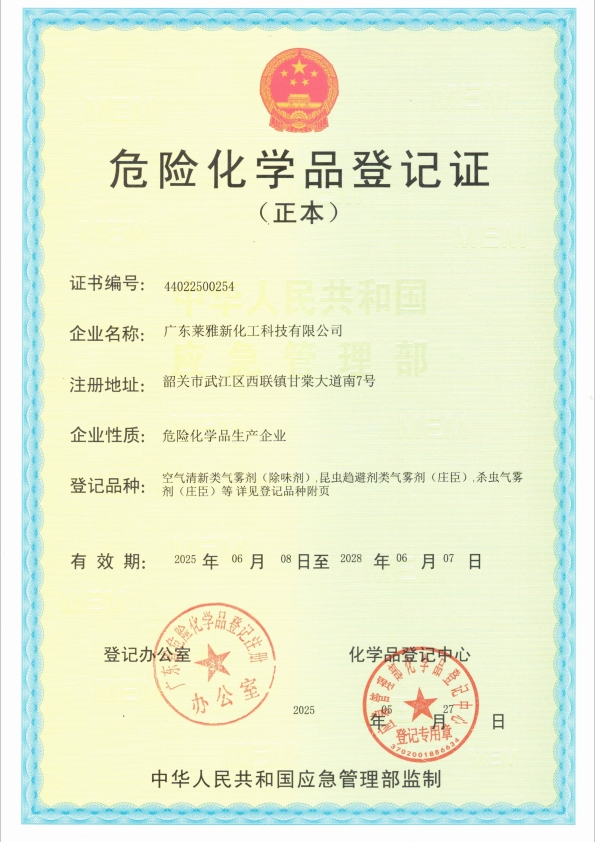
- Hazardous Chemical Registration Certificate, certificate number 44022500254, issued by the Ministry of Emergency Management of the People's Republic of China, issued 8 June 2025 and valid to 7 June 2028, covering air freshener aerosols (odor eliminators), insect repellent aerosols and insecticide aerosols, among others listed in the annex.
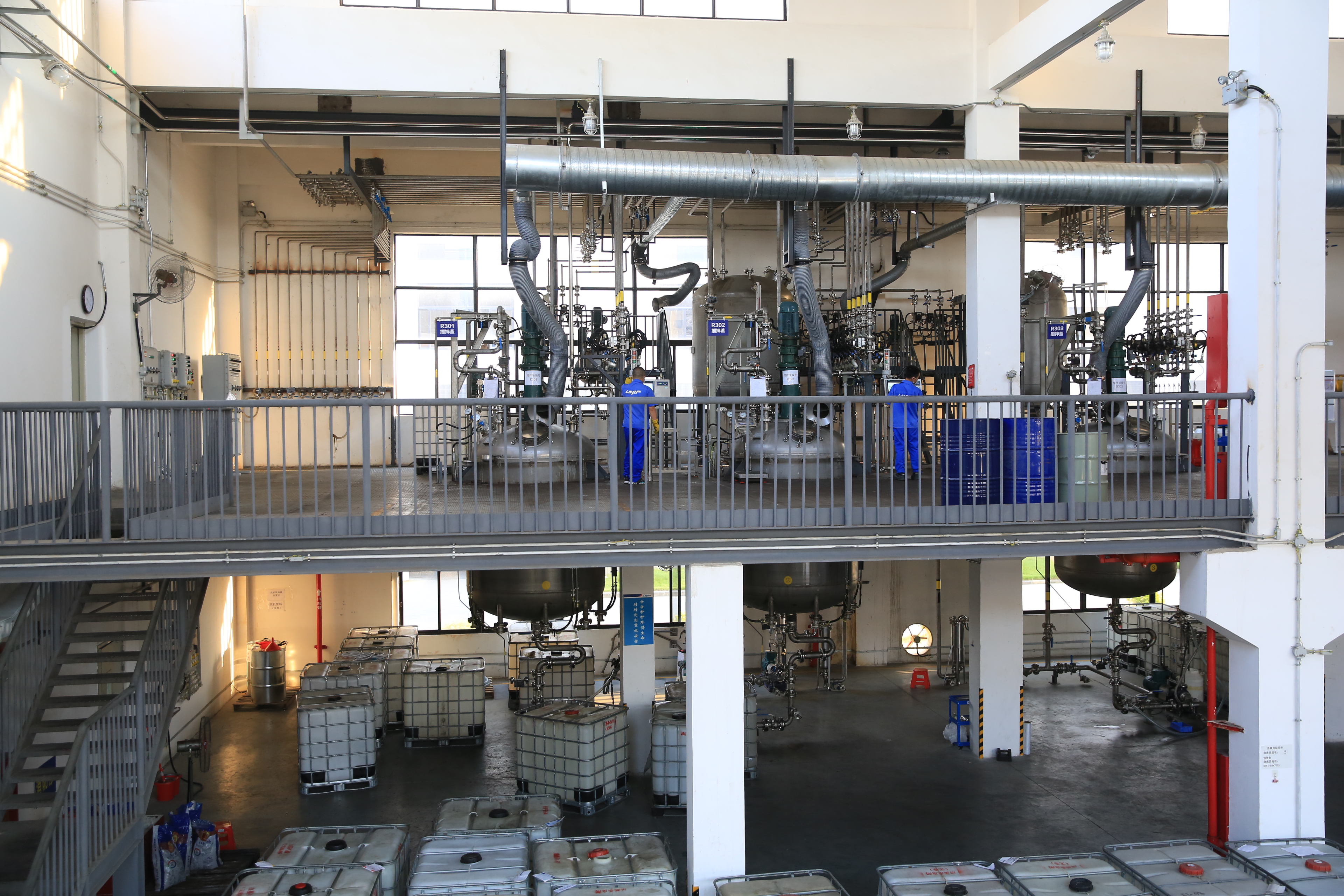
On the production side, LAYA operates from a 100,000 m² site with 50,000 m² of modern standard workshops and 14 advanced filling lines, with an annual output of 200 million cans of various products. The technical centre contains 4 product development laboratories and 7 analytical testing laboratories and is staffed by 15 engineers. Stated quality control covers 100% leak test, pressure test and visual inspection. These figures are the ones a first-time buyer should cross-check against the category being specified, because they indicate which production steps are handled in-house rather than outsourced.
Use cases and configuration scenarios
The clearest documented example in the catalogue is an air freshener project for an aerosol OEM client in Bulgaria, with a project scale of 30,000 units and a duration of 2 years. The application covers household odor removal, car air freshening and commercial space fragrance. The formulation is extracted from osmanthus and is described as a natural plant-based formula with long-lasting fragrance for multi-scenario use. The product corresponds to air freshener ME-0000300: tinplate, 300 ml net content, ∮52 × 195 mm can dimension. For a buyer, this case shows how a single compact can body can serve three different end-use environments when the fragrance and packaging are specified together.
The configurations below are specification scenarios derived from the catalogue data in this article; they are not presented as completed projects.
- Scenario A — retail insecticide programme. A buyer targeting a multi-market retail listing would work within the KB-0000600 range, choosing between 300 ml and 750 ml fill volumes and the corresponding can bodies from ∮52 × 195 mm up to 65 × 300 mm, all in tinplate.
- Scenario B — aviation cleaning aerosol. An aviation procurement team specifying an MRO aerosol would work with KB-0000300 in the 300–600 ml range, and would need to decide early between tinplate and the listed aluminum can option, because that decision affects weight, handling and label messaging.
- Scenario C — industrial and automotive maintenance lines. Industrial maintenance SM-0000400 and car care BO-0000600 share the same 300–600 ml fill range and the same four can dimensions, which allows a distributor to run two product families on a common pack footprint while keeping formulations separate.
- Scenario D — household cleaning and spray paint. QL-0000300 and QL-0000450 also share the 300–600 ml range and four can dimensions, useful for brands that want one can format across a cleaning line and a paint line without re-tooling artwork templates.
Comparison table: seven aerosol categories side by side
| Product category | Model | Can material | Net content | Can dimensions (diameter × height) | Listed application industry |
|---|---|---|---|---|---|
| Insecticide spray | KB-0000600 | Tinplate | 300 / 400 / 500 / 600 / 750 ml | ∮52 × 195 / 65 × 158 / 65 × 200 / 65 × 240 / 65 × 300 mm | Insecticide |
| Air freshener | ME-0000300 | Tinplate | 300 ml | ∮52 × 195 mm | Public & Commercial Services |
| Household cleaning aerosol | QL-0000300 | Tinplate | 300 / 400 / 500 / 600 ml | ∮52 × 195 / 65 × 158 / 65 × 200 / 65 × 240 mm | Home & Daily Life |
| Spray paint aerosol | QL-0000450 | Tinplate | 300 / 400 / 500 / 600 ml | ∮52 × 195 / 65 × 158 / 65 × 200 / 65 × 240 mm | Public & Commercial Services; Home & Daily Life |
| Car care aerosol | BO-0000600 | Tinplate | 300 / 400 / 500 / 600 ml | ∮52 × 195 / 65 × 158 / 65 × 200 / 65 × 240 mm | Transportation; Industrial & Manufacturing |
| Industrial maintenance aerosol | SM-0000400 | Tinplate | 300 / 400 / 500 / 600 ml | ∮52 × 195 / 65 × 158 / 65 × 200 / 65 × 240 mm | Industrial & Manufacturing |
| Aviation aerosol | KB-0000300 | Tinplate; aluminum can | 300 / 400 / 500 / 600 ml | ∮52 × 195 / 65 × 158 / 65 × 200 / 65 × 240 mm | Aviation |
Source: LAYA product documentation. Comparison is based on recorded model specifications only; no performance ranking between categories is implied.
FAQ
Which certificates should a buyer verify before placing an aerosol OEM order?
Four documents are held by LAYA and each carries its own scope and validity period: ISO 9001 certificate number 180708, issued by DCl Certification Ltd to GB/T 19001-2016 idt ISO9001:2015 (valid to 3 June 2027); ISO 14001 certificate number F02925E00035R202, issued by DCI Certification Ltd to GB/T 24001-2016 / ISO14001:2015 (valid to 17 December 2028); ISO 45001 certificate number 200894, issued by DCI Certification Ltd to GB/T 45001-2020 idt ISO45001:2018 (valid to 16 December 2026); and Hazardous Chemical Registration Certificate number 44022500254, issued by the Ministry of Emergency Management of the People's Republic of China (valid to 7 June 2028), which covers air freshener aerosols, insect repellent aerosols and insecticide aerosols. Destination requirements sit on top of these: in the EU, the Aerosol Dispensers Directive requires mandatory deformation and burst tests with resistance requirements of up to 10–15 bar depending on propellant type, and in China the Hazardous Chemicals Safety Law takes effect on 1 May 2026, introducing whole-lifecycle safety management for production, storage and transport.
What customization can be requested within aerosol OEM/ODM production?
The published customization scope covers formula customization, packaging design, logo printing, can size customization and fragrance adjustment, delivered through OEM and ODM production services for aerosol products. Capacity and technical depth behind that scope are stated as a 100,000 m² site with 50,000 m² of modern standard workshops, 14 advanced filling lines, an annual output of 200 million cans, a monthly capacity of 1 million cans, and a technical centre with 4 product development laboratories, 7 analytical testing laboratories and 15 engineers. For a buyer, the practical implication is that can size customization should be raised at the same time as formulation work, not after artwork approval, because the two decisions constrain each other.
What are the minimum order quantity and the standard commercial terms?
The published purchasing terms are: minimum order quantity 10,000 pcs; delivery terms TT/LC; acceptance criteria preshipment test; and payment terms negotiable based on order quantity. Because payment terms are stated as negotiable against order quantity, buyers should present the total project volume — including any later repeat orders — rather than the first shipment alone when opening the commercial discussion.
Can a can size and a formulation be validated before bulk production?
Validation is structured around the specification items themselves rather than around a fixed sample programme. Can size customization, formula customization and fragrance adjustment are all listed as available, and the stated acceptance criterion for an order is preshipment test, supported by 100% leak test, pressure test and visual inspection under an ISO 9001 certified quality control system. A buyer should therefore confirm three things before bulk production: the exact can body corresponding to the target fill volume, the can material (tinplate as the base material, or the aluminum option listed for the aviation aerosol KB-0000300), and the preshipment test protocol. Sample requests and specification questions can be sent to echo@laya.com.cn or via WhatsApp on +86 136 5384 8383.
What production lead time and after-sales support apply?
Lead time is quoted at 7–15 days. After-sales support covers remote technical support, order tracking, after-sales consultation and product quality follow-up. Buyers planning a first aerosol order should map the 7–15 day production window against their own artwork approval cycle, because logo printing and packaging design are part of the same customization scope and sit upstream of the production slot itself.
Conclusion: the order of decisions matters more than the volume of information
For a first-time B2B aerosol buyer, the useful sequence is short: choose the category, confirm the can material, fix the net content and can dimensions, define the customization scope, then close the compliance and commercial questions. Everything else — supplier capability, capacity and service level — becomes easier to evaluate once those five items are written down, because they turn a general inquiry into a specification that any manufacturer can quote against.
Applied to LAYA's catalogue, that sequence resolves into seven model families: KB-0000600 for insecticide spray, ME-0000300 for air freshener, QL-0000300 for household cleaning, QL-0000450 for spray paint, BO-0000600 for car care, SM-0000400 for industrial maintenance and KB-0000300 for aviation aerosols — with tinplate as the base can material across the range and aluminum listed as an option for the aviation model.
Next step: turn your category choice into a quoted specification
If you are specifying your first aerosol order, send the category, target market, fill volume and preferred can material to the LAYA team and request a specification review against the model range above. Sample evaluation, formulation discussion and packaging design can be handled in the same conversation.
Email: echo@laya.com.cn | WhatsApp: +86 136 5384 8383 | Website: www.laya.com.cn/en/
Download the full product catalogue: LAYA aerosol product catalogue (PDF)
Guangdong Laya New Chemical Technology Co., Ltd., No. 7, Gantang Avenue South, Xilian Town, Wujiang District, Shaoguan City, Guangdong Province, China 512000.

Have Questions or Need More Details?
Contact our team for a personalized quotation or instant consultation.
Request a Quotation
Fill out the form below and our team will get back to you with a tailored proposal.
WhatsApp Direct Chat
Prefer to chat in real-time? Message us on WhatsApp for instant assistance & quick answers.
- Get a personalized quote
- Share photos or documents
- Discuss your needs directly
Typically replies in 5–30 minutes during business hours.