
Aerosol Can Dimensions & Fill Volume: A Daily-Use Guide
Aerosol Can Dimensions and Fill Volume Selection for Daily-Use Products

Can dimensions and fill volume are settled at the specification stage, before a formula reaches the filling line. Image: LAYA Technology Center.
For a daily-use aerosol SKU, the workable sequence is: fix the net fill volume first, convert it into an internal volume requirement that includes propellant and headspace, choose the can diameter, and only then choose the height. Done in that order, the can specification maps directly onto filling-line parameters, carton configuration, label panel area and the acceptance criteria written into an OEM purchase order. Done in the reverse order — picking a can that looks right and hoping the fill fits — the same net content ends up spread across two different can formats that both have to be renegotiated whenever one of them changes.
Problem Definition: Why Can Specifications Go Wrong
The decision that most often destabilises a daily-use aerosol project is rarely the formula. The more common failure is that the formula is settled, the brand pack is settled, and only then does anyone try to fit the product into a can that will hold it — or, worse, into a can that will not.
Three practical consequences follow.
- Net content that does not respect can geometry. A 300 ml fill placed in a body designed for 400 ml means a redesigned container. The same fill placed in a body designed for far less means the declared net content has to shrink, unit economics move, and the retailer is handed a different pack size.
- Diameter treated as an afterthought. Two cans carrying the same fill can differ purely by diameter, and that difference changes label wrap width, hand feel, and the number of units per carton and per pallet. Any one of those alters the packaging cost line.
- Acceptance criteria that were never written down. Without pressure testing, leakage limits, coating integrity and print registration tolerance specified in the purchase order, "what counts as a conforming can" becomes an interpretation rather than a contract term.
The problem this guide addresses is not which can is best in the abstract. It is which specific combination of body format, net fill volume, target market and expected annual volume fits one SKU — and how a procurement team can lock that combination before the request for quotation goes out.
Industry Background: What the Aerosol Packaging Base Looks Like
Aerosol packaging remains a large global category. Grand View Research estimates the global aerosol market at USD 100.7 billion in 2026, covering personal care, household, automotive, industrial, medical and food segments.
In physical terms, European aerosol production reached 3.46 billion units in 2024, a 4.2% year-on-year increase, according to the European Aerosol Federation. That figure is useful to procurement teams selling into the EU because it is expressed in units rather than value, and is therefore less distorted by price structure.
By material, Grand View Research estimates aluminium packaging at 61.0% of aerosol container revenue in 2025 and steel containers at 39.0%. Those are revenue shares, and revenue shares lean towards higher-priced segments. For price-sensitive daily-use lines — household cleaning, air freshener, insecticide, entry-level coatings — tinplate (tin-coated steel) is the container family that specification decisions are actually made in, and it is the scope of everything that follows.
On the supply side, Guangdong Laya New Chemical Technology Co., Ltd. operates an aerosol plant established in 1992 with a 100,000 m² production base that includes 50,000 m² of standard workshops and 14 filling lines, reporting annual output of 200 million cans and approximately 300 employees. LAYA's listed portfolio covers insecticide spray, air freshener, household cleaning aerosol, industrial maintenance aerosol, car care aerosol, disinfectant aerosol, aviation aerosol and spray paint aerosol, supported by R&D, manufacturing and ODM/OEM services. These figures are company-reported and should be confirmed by factory audit and documentary verification during supplier qualification.
The Technical Solution: Tinplate Construction and the Available Format Set
Tinplate construction and what it means for fill volume
A tinplate aerosol can is built from a steel body with a tin coating, a welded or bonded seam, a bottom dome, a top dome and a valve cup. An internal lacquer separates the formula from bare metal, and for water-based or mildly acidic household cleaning formulations that lacquer matters as much as the can dimensions themselves.
The constraint this places on a buyer is straightforward: whatever net fill volume appears on the label has to fit inside the internal volume, with room left for propellant and headspace. Headspace is not waste. Once the can format and valve are fixed, it becomes a fixed input to pressure-temperature behaviour, spray performance and evacuation at end of use.
The structural trade-off repeats at every format. A wider body gives more volume per millimetre of height but increases label circumference and changes how many units load into a carton and onto a pallet. A taller body keeps a narrow footprint but moves the centre of gravity and changes stacking behaviour and shelf presence.
Diameter moves capacity faster than height does
Internal volume scales with the square of the radius but only linearly with height. Moving from a 52 mm diameter body to a 65 mm diameter body enlarges the cross-sectional area available per millimetre of body height by roughly 56%. That is why a 195 mm tall 52 mm body holds a smaller net fill than a 158 mm tall 65 mm body, even though its body is 37 mm longer.
For a buying team, the practical rule is: settle the diameter first and the approximate fill band settles with it. Height then tunes within that band rather than defining it.
The five body formats in this set
The format set examined here is ∮52 × 195 mm, ∮65 × 158 mm, ∮65 × 200 mm, ∮65 × 240 mm and ∮65 × 300 mm. Four share a single diameter; one uses a narrower profile.
- ∮52 × 195 mm — the compact format. Narrow shelf footprint, higher units per pallet, and a label panel suited to short copy and small face sizes.
- ∮65 × 158 mm — the shortest of the 65 mm bodies. Wide label circumference carried on a short body, useful where brand visibility matters more than maximum content.
- ∮65 × 200 mm — the mid-height body. A balanced ratio of circumference to body length, and the format most often considered a workhorse.
- ∮65 × 240 mm — the extended body. Carries a higher fill and offers a longer panel for multilingual or multi-line declarations.
- ∮65 × 300 mm — the tallest format in the set. Largest single-can capacity, highest centre of gravity and the largest carton cube.
The five net fill options
The available net fills are 300 ml, 400 ml, 500 ml, 600 ml and 750 ml. These are fill volumes, not can volumes. The difference between the two has to accommodate propellant, headspace and mixing tolerance.
As a working rule, a 300 ml fill sits on the smallest body that supplies the required internal volume — in this set the ∮52 × 195 mm format. The 400 ml and 500 ml fills sit comfortably on the ∮65 mm diameter bodies at 158 mm and 200 mm heights. The 600 ml and 750 ml fills need the extra internal volume that faster body length provides, which points to ∮65 × 240 mm and ∮65 × 300 mm.
Reference models: what QL-0000300, ME-0000300, KB-0000600 and QL-0000450 show
Reference models make the logic concrete at catalogue level. QL-0000300 and ME-0000300 both sit in the 300 ml band, yet they exist as separate models — which is the useful signal: the same net fill can be delivered by more than one body configuration once diameter, valve choice and lacquer system are allowed to vary.
KB-0000600 sits in the 600 ml band, where body length becomes the deciding variable. QL-0000450 sits in the mid band between the compact and the extended formats and illustrates how one fill range can be served by a body that does not sit at either extreme of the set. Read side by side, the four models support a rule that applies to any supplier: the net fill band narrows the can choices; the diameter then chooses the model.
Coatings, valves and headspace: the parts of the volume budget buyers forget

Propellant supply and pressure control sit behind every headspace decision on a can specification. Image: LAYA oil and gas depot.
Three variables change the outcome once the body is chosen: the internal lacquer system, the valve type, and the share of internal volume reserved for headspace.
The lacquer must match the formulation chemistry. A coating specified for a solvent-borne spray is not automatically the right choice for a water-based household cleaner, and a coating mismatch typically shows up as corrosion, valve blockage or pressure loss after storage rather than immediately.
The valve determines discharge rate and spray pattern. The same body and the same declared fill become two different products once the valve and actuator change.
Headspace is the volume deliberately left unfilled inside the can. Too little, and internal pressure climbs excessively as temperature rises. Too much, and more propellant is needed to reach working pressure while spray quality degrades towards the end of the can.
All three belong in the quotation and sample stage — not in a default carried over from whatever body was specified last time.
Step-by-Step: How to Select a Format for a New SKU
- Fix the net fill volume before anything else. Establish the commercial requirement in millilitres of deliverable product, not in can size. Every downstream decision — body format, valve, carton, freight — is derived from this number.
- Convert net fill into an internal volume requirement. Add propellant volume, headspace and mixing tolerance. If the net fill sits close to the upper limit of a candidate body, step up one format rather than compressing the headspace allowance.
- Choose the diameter, not the height. Diameter sets cross-sectional area, and cross-sectional area sets label circumference, hand feel and units per carton. Settle those three before touching height.
- Use height to fine-tune the remainder. With the diameter locked, use height to carry the fill within the volume budget and to align with shelf facings, existing carton dimensions and filling-line guides.
- Verify valve and actuator compatibility at the same time. The valve, actuator and nozzle combination must produce the required spray pattern and discharge rate at the intended fill pressure. Validate this on the chosen body before the format is frozen.
- Write the acceptance criteria into the purchase order. At minimum: can dimensions, tinplate thickness and lacquer specification, net fill volume, propellant type and fill weight, valve and actuator specification, pressure test conditions, leakage limits, print colour count and registration tolerance, and carton and pallet configuration.
- Confirm target-market compliance before requesting a quotation. Aerosols sold in the EU fall under the Aerosol Dispensers Directive (75/324/EEC), which mandates pressure testing and specific labelling. Confirm that requirement, plus any category-specific licensing for insecticide or disinfectant products, before filling is scheduled.
Without these seven items settled up front, a project spends its quotation stage in a "flexible can format" condition — where a single change cascades into filling-line resets, new print plates, redesigned cartons and a fresh round of stability testing.
Use Cases: Where Each Category Lands
Household cleaning aerosol
Household cleaning formulations tend to compete on value per use rather than per can. Because the spray covers a surface rather than treating a point, many SKUs land in the 400–600 ml range where unit economics balance. The ∮65 × 200 mm and ∮65 × 240 mm bodies carry that range while keeping a face wide enough for shelf blocking. Formulations are often water-based or mildly solvent-borne, so the internal lacquer should be selected against the specific formulation rather than inherited from a different product line.
Air freshener
Air fresheners usually differentiate on valve and actuator, not on can capacity. A 300 ml fill on the ∮52 × 195 mm body keeps a multi-SKU range narrow in pallet footprint and compact in carton cube. Where a SKU needs a larger printed panel — for a scent variant, a promotional message or multilingual EU labelling — shifting to the ∮65 mm diameter at 158 mm or 200 mm height buys panel area without changing the fill band.
Insecticide spray
Insecticide is constrained on both counts: the net fill has to support the number of treatments implied by the label directions, and the label panel has to hold hazard pictograms, hazard statements and registration information. The ∮65 × 240 mm body carries both — enough internal volume for a 500–600 ml fill alongside a full declaration panel. Licensing and label requirements for pest-control products vary by market and should be reviewed before the format is confirmed, since a late label change can force a change in panel area.
Spray paint aerosol
Spray paint runs heavier. A 750 ml fill is delivered on the ∮65 × 300 mm body, and a 600 ml fill on the 240 mm body. Diameter here is driven by printing and regulation rather than ergonomics: colour coding systems, hazard pictograms and application instructions compete for the same label panel, and a wider circumference buys panel area directly.
Industrial maintenance and car care
Both are typically solvent-borne and often share a can family. The purchase decision then centres on shelf consistency and pallet efficiency across a range rather than on the largest single fill, which is why a mixed line of 400 ml and 500 ml SKUs on a common 65 mm diameter can be easier to manage than a line optimised can by can.
Comparison Tables
Can format comparison
| Can format | Diameter × height | Structural character | Where it typically fits |
|---|---|---|---|
| ∮52 × 195 mm | 52 mm × 195 mm | Compact footprint; less internal volume per millimetre of height than the 65 mm bodies | 300 ml fills; narrow label panel; high units per pallet |
| ∮65 × 158 mm | 65 mm × 158 mm | Shortest 65 mm body; wide circumference carried on a short body | 400 ml fills where total can height is constrained |
| ∮65 × 200 mm | 65 mm × 200 mm | Mid-height body balancing panel area and cube | 400–500 ml fills; workhorse retail formats |
| ∮65 × 240 mm | 65 mm × 240 mm | Extended body; larger label panel | 500–600 ml fills; multilingual and hazard-heavy labels |
| ∮65 × 300 mm | 65 mm × 300 mm | Tallest format; largest single-can volume and carton cube | 600–750 ml fills; spray paint and higher-volume categories |
Supplier positioning: what LAYA discloses, and what a buyer still has to verify
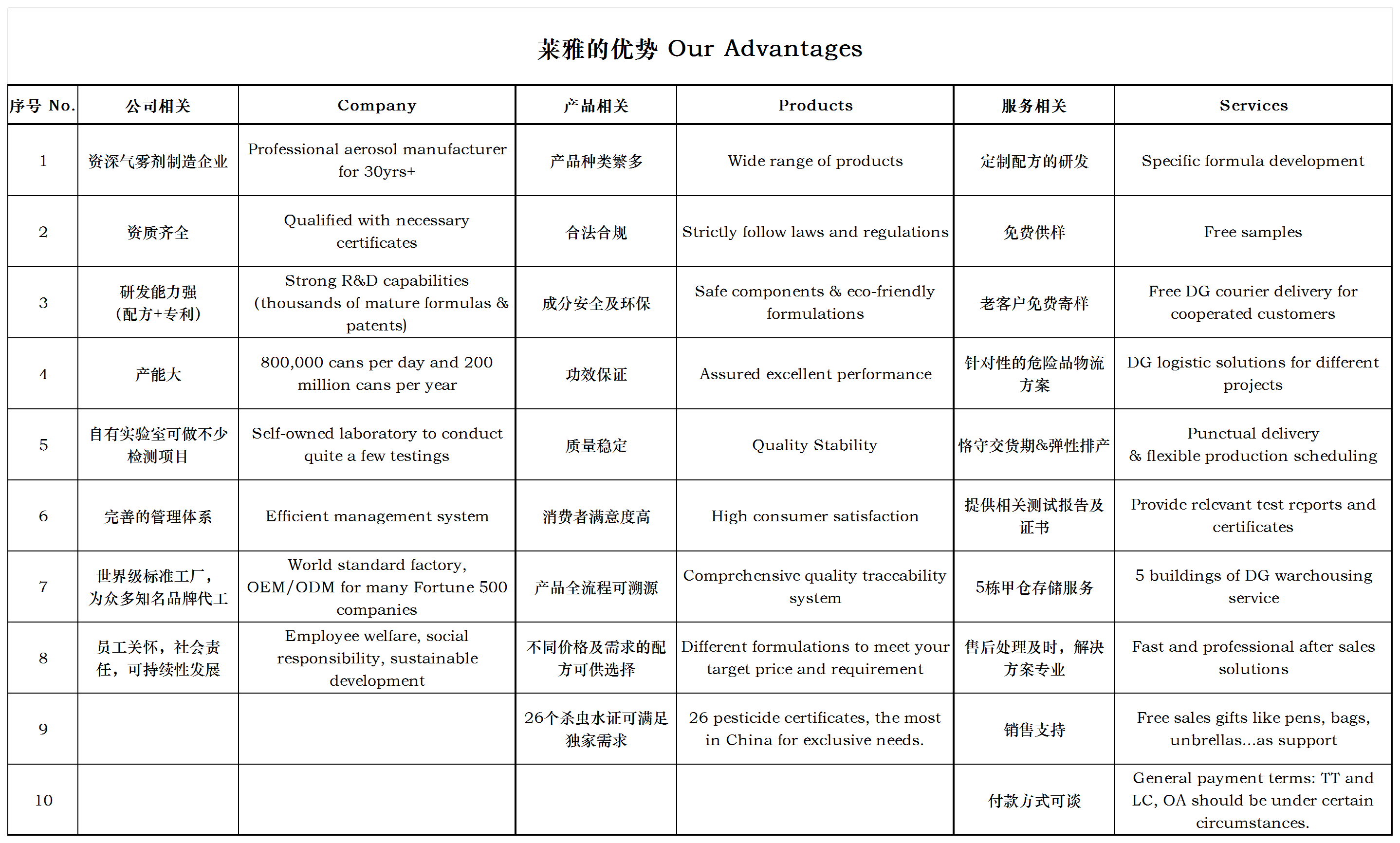
A supplier's disclosed position is a starting point for qualification, not a substitute for it. Image: LAYA supplier advantages summary.
| Dimension | What LAYA discloses | What the buyer still needs to verify |
|---|---|---|
| Systems and laboratories | Comprehensive system certifications, an independent R&D laboratory, and professional OEM/ODM services | Certification scope, issuing body, certificate numbers and validity dates |
| R&D and testing depth | 4 product development laboratories and 7 analytical testing laboratories, with 15 engineers in the technical team | Test protocols applied to the specific can format and formulation in question |
| Service scope | R&D, manufacturing, sales and ODM/OEM services across insecticide spray, air freshener, household cleaning, industrial maintenance, car care, disinfectant, aviation and spray paint aerosols | Category-specific licences and formulation capability for the intended product |
| Manufacturing depth | 14 advanced filling lines, 100,000 m² site, stated annual output of 200 million cans | Line utilisation, minimum batch size and achievable lead time for the ordered format |
| Cost logic | Standardised production controls comprehensive cost; formula and packaging can be customised to match different budget requirements | SKU-level quotation, tooling and print plate costs, and packaging cost breakdown |
| Finished-product handling | Finished aerosol supplied ready for use, with no additional assembly or maintenance required | Shelf life and storage conditions applicable to the chosen format and formula |
Frequently Asked Questions
What regulatory requirements apply to tinplate aerosol cans for daily-use products sold in the EU?
Aerosols sold in the EU fall under the Aerosol Dispensers Directive (75/324/EEC), which mandates pressure testing and specific labelling for all aerosols placed on the market. Beyond the directive, formulation categories carry their own requirements: insecticide and disinfectant products generally involve production licensing and market-access rules. Can dimensions do not change these requirements, but they do determine the label panel — a wider circumference gives more room for hazard pictograms, hazard statements and supplier information. Buyers should confirm that the OEM supplier holds valid, category-appropriate licensing for the intended product and market before placing an order.
Can the same formulation be run in more than one can diameter?
Yes, and the format set is built for it. Four of the five cans covered in this guide share a single 65 mm diameter, so one formulation can be filled across the 400 ml to 750 ml range without reformulation. LAYA reports 14 filling lines and a stated annual output of 200 million cans, with OEM/ODM services spanning eight aerosol categories. What still has to be confirmed at SKU level is that the chosen valve, actuator and internal lacquer are validated on each specific body, because the same formulation behaves differently when can size and valve change.
How do can size and fill volume affect unit cost?
Three components move together: tinplate and lacquer consumption, net fill volume (formulation plus propellant), and packaging and freight cube. Moving from a 300 ml fill to a 750 ml fill within this set increases formulation volume and can material, reduces units per carton, and raises freight cost per unit. Standardised production controls hold the base cost down, and customised formula and packaging can be adjusted to different budget requirements. The reliable method is to request the candidate formats quoted side by side, so formulation, valve and print costs are compared on identical terms.
Should the can and fill volume be validated on samples before a bulk order?
Yes — a filled sample evaluated against a written specification is the standard way to lock a format. Buyers should request a filled sample together with the specification sheet it was produced against, then assess can appearance, leakage behaviour at the intended storage temperature, spray pattern and discharge rate, and a full-can evacuation test to confirm the declared net fill is genuinely deliverable. An unfilled can sample is useful in parallel, because it validates print registration, lacquer appearance and shelf presentation without the cost of a filled run.
Does the choice of can dimensions and fill volume affect lead time?
Lead time is driven by can availability and filling scheduling, and both shift with the specification. Conventional bodies in a standard diameter are usually easier to schedule than non-standard heights or special diameters, and print plates require lead time for every new can circumference and artwork — a cost that recurs when artwork is reordered. For those reasons, lead time should be agreed as a specific commercial term in the purchase order rather than inferred from the can size, with separate milestones for print plates, internal lacquer and first-article release. Where a team is comparing several formats at once, listing the candidate formats and fills in a single request lets the supplier quote formulation, valve and print costs on identical terms.
Conclusion
Can dimensions and net fill volume are not two separate decisions that happen to sit next to each other on a specification sheet. Diameter determines how much internal volume is available per millimetre of body, height tunes the remainder, and the declared fill volume only works when propellant and headspace fit inside the difference. In this format set, that logic produces a clear structure: 300 ml on the compact ∮52 × 195 mm body, 400 ml and 500 ml on the ∮65 mm diameters at 158 mm and 200 mm, and 600 ml and 750 ml on the extended 240 mm and 300 mm bodies.
What separates a controlled project from a difficult one is whether those choices reach the purchase order as acceptance criteria — can dimensions, lacquer specification, fill weight, valve specification, pressure and leakage testing, print tolerance, carton configuration — or whether they arrive later as an interpretation of what was meant. Reference models such as QL-0000300, ME-0000300, KB-0000600 and QL-0000450 exist precisely because more than one body configuration can serve a declared fill; deciding which one is a specification task, not a catalogue task.
Turn the specification into a working request
If you are comparing can formats or net fill volumes for a daily-use SKU, the fastest route is a short brief: product category, target net fill, target market and expected annual volume. That combination can be answered with body format, valve options and acceptance criteria together, rather than with a unit price alone.

Download the LAYA Product Brochure (PDF)
Guangdong Laya New Chemical Technology Co., Ltd. · www.laya.com.cn/en/ · echo@laya.com.cn · WhatsApp +86 136 5384 8383 · No. 7, Gantang Avenue South, Xilian Town, Wujiang District, Shaoguan City, Guangdong Province, China 512000
Have Questions or Need More Details?
Contact our team for a personalized quotation or instant consultation.
Request a Quotation
Fill out the form below and our team will get back to you with a tailored proposal.
WhatsApp Direct Chat
Prefer to chat in real-time? Message us on WhatsApp for instant assistance & quick answers.
- Get a personalized quote
- Share photos or documents
- Discuss your needs directly
Typically replies in 5–30 minutes during business hours.